
The Magic Kingdom
Virtually all of our modern arts and sciences have roots in the ancient practice of Egyptian magic
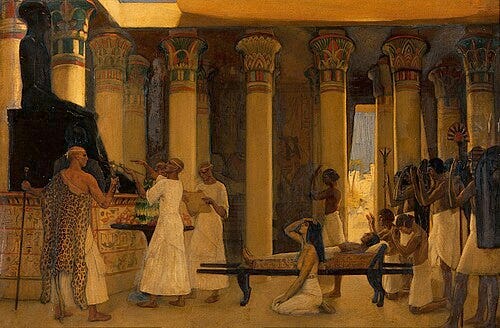
“Egypt,” quipped one ancient commentator, “is the mother of magicians.” Within the context of the ancient Mediterranean, such a claim was hardly exaggerated; any serious Iron Age scholar who aspired to master any branch of the magical arts, from alchemy to sorcery, from astrology to divination, from the invocation of the gods through magical amulets to elaborate passion plays which served the same purpose, went to Egypt.
What the Egyptians didn’t invent, they borrowed. For long periods during the Middle and New Kingdoms, the pharaohs of the Nile expanded their empires well into the Middle East; and from the conquered lands of the Levant they adopted not only technological innovations like the chariot but also rich cultural influences. In particular, the studies of Chaldean and Persian astrology picked up in eastern campaigns quickly found their way into Egyptian ars magica, lending a cosmic dimension to the discipline which would eventually pave the way for the Ptolemaic model of the universe, developed in Alexandria.
By the time that the writings which would eventually become the Hebrew and Christian Bibles had been written, edited and compiled, the influence and renown of Egyptian magicians had spread so wide and so deep that its fingerprints could hardly be extricated from any of those sacred scriptures. In fact, so many of the biblical tales and myths that I learned in Sunday school were inspired by (or, indeed, copied from) older Egyptian myths, I found myself continually shaking my head in recognition as I went deeper and deeper in this little amateur excursion into Egyptology.
It took months of research and study before I felt comfortable writing with any authority about this extraordinary ancient culture; I thank everyone for their patience. Now that I finally feel ready, I present this new series on the true Magic Kingdom — a cultural monolith which stood resolute in the desert, beside the banks of the mighty Nile, for nearly three thousand years.
Magic Vs. Science? Magic As Science? Science as Magic?
What is magic? After having spent some time in the company of Egyptian priest-magicians, some part of me is tempted to claim that magic is essentially the same inquiry as science, only proceeding along different paths and from different premises. And indeed, from the Egyptian point of view, the study of knowledge, especially esoteric knowledge, was considered an essential occupation of any magician. I don’t know who first claimed that “knowledge is power,” but I can certainly attest that the sentiment which lies behind such words was pioneered in ancient Egypt.
Yet this definition fails to satisfy. While the practice of Egyptian magic certainly shares a love of erudition in common with our modern, empirical inquiries, it placed an equal, if not greater, emphasis on the importance of the imagination, the interior world of mental images which esoteric philosophers of the European Middle Ages called the realm of phantasy. Thus it is no coincidence that the Hebrew story of Joseph, as related in the book of Genesis, claims that Joseph found the favor of the pharaoh’s court by demonstrating his talents for the interpretations of dreams. Dreams, as expressions of pure phantasy, unattenuated from the empirical worlds of modern science, were seen by the Egyptians (as well as the Greeks and Hebrews) as messages from the gods. Thus, Joseph established his cred by proving that he was a powerful magician in the Egyptian style — he was so learned, so insightful, that he could magically divine the will of the gods (or God, as the case may be) more effectively than even the best of the Egyptian wizards.
This reputation for mastery of the occult sciences endured long after Egypt’s golden ages had faded into the sands. Well into the Middle Ages, European scholars spent their lives in search of the secrets of the legendary Emerald Tablets of Hermes Tresmegistus, among other esoteric works written by other famous Egyptian magicians. Indeed, the entire discipline of European alchemy was essentially copied from Egyptian magicians (the Arabic word al-kemi, lit. “the black land”, was an ancient name for the land of the Nile).
Though the universities of Europe, China and the Middle East eventually developed modern empiricism, magic never entirely went away. As professor Coulianou argues, the insights of the ancient magicians have essentially been reconstituted and reformulated by the work of very modern scientists, such as those who work in depth psychology and in the fields of marketing and advertising. The truly magical insight is realizing that the horizon of what we can see inevitably limits the decision set of what we can choose to do — an insight which the HBO show The Last of Us exploits to potent and horrific effect. The magician is the one who can manipulate the internal images of others in order to, quite literally, transform their world.
The Legacy of Magic
The foregoing does a pretty good job of introducing Egyptian magic, but I remain far from satisfied. My modern European worldview insists on siloing knowledge, separating science from magic and firewalling them. The Egyptians had no such hangups. Their magic also included a great deal of what we, today, would consider empirical.
Consider medicine. Egyptian magicians performed many of the same functions that physicians do today, and through similar means. When it came to a sick patient, Egyptian “magic” was essentially the same as herbalism, as we think of it today; Galen, the most famous and authoritative source on European medicine throughout the entire Middle Ages, studied in Egypt.
Consider our modern universities, the bastions of modern empiricism. While they owe essentially half of their cultural heritage to institutions of Greek philosophy (Plato’s famed Academy in Athens is often held up as the prototypical example), the other half comes from the traditions of Egyptian priest-librarians, whose principal profession was the working of magic. Not only Hogwarts, but also every IRL university on Earth, owes a cultural debt to Egyptian institutions like the Serapeum of Alexandria, which was part library, part catacombs, part ritual center, and all magic.
Consider religion. While the philosophical and spiritual foundations of Christian culture may have been founded on Platonic theories of the transmigration of the soul, they all derive considerable influence from the magic of Egyptian myth. Setting aside comparisons between the stories of the Christian Passion and the much older myths about the passions of Osiris and Isis, the very idea of the Christian soul, so central to the theologies of the world’s most popular religion, would have been literally inconceivable had the Egyptians not first laid the philosophical groundwork for it. Egyptian funerary magic, with its stories of Osiris, Lord of the Underworld, and Anubis with his scales to weigh the souls of departed against the weight of a feather, seeded neighboring cultures with the idea that a human soul endures, even after the body dies. Where would Christianity be without that?
Finally, consider the theater. Egypt was replete with theaters, and its people obsessed over the art form even more than the Greeks did. For them, it was no mere entertainment; it was an elaborate magic ritual which invoked the presence of the gods among the people. This legacy endures to the present day in cineplexes the world over; the entire industry of special and visual effects which dazzles movie-going audiences today was born in Egypt, where theatrical productions joined together with what we would now call stage magic, all with the purpose of committing inception on the audience — placing images within the stream of their phantasies, with the purpose of not only entertaining but literally transforming the consciousnesses of those who attend.
It is no coincidence, therefore, that the earliest Christians went to great effort to worship their god through the production of so-called “Passion plays”. My high school teacher told me that they did this in order to tell the story of Christ, even to the illiterate; but this explanation, while not wrong, stops far short of the full truth. In fact, Passion plays, like the other rituals of the Christian church, are adaptations of Egyptian magic rituals, designed to re-enact the redemption of the world by re-enacting the events which led to it.
In future installments of this series, I’ll go into that last insight in much greater depth. For now, and to wrap up, I’ll leave you with this: magic is not only not gone from the earth, it’s actually bigger than ever. And, as with so many other great cultural gifts, we have the Egyptians to thank for that.