The Truth About the Pope that the Vatican Doesn't Want You to Know
For most of the history of the papacy, the Pope was known as an explicitly sexual figure - the opposite of the celibate norms of today
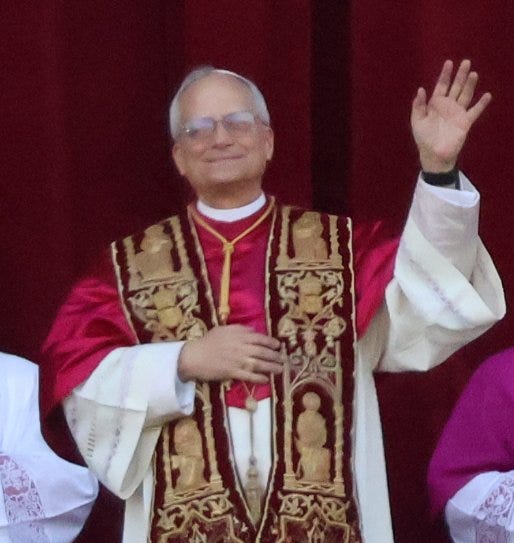
I interrupt our usual Substack schedule for these important messages concerning that old white guy everyone’s talking about: the Pope.
In this post, I dive into some fascinating historical facts about the papacy that the Vatican would prefer you didn’t know. These facts are very much related to my project here at The Erotic Gospel, since they reveal that sacred sexuality has been intrinsic to the papal office for a very, very long time. In fact, it was only relatively recently that the Catholic church did a 180 on the question of papal celibacy; only a few hundred years ago, the rule was exactly the opposite.
No doubt, these claims will require some unpacking. The evidence for them comes from three primary sources: etymological, historical and symbolic.
“Il Papa”
The English word “pope” is misleading. For reasons which I have not uncovered, the English lexicon diverts from the original Latin/Italian by changing its vowel sound into an “O.” Were it not for this loss in translation, the explicitly sexual-generative nature of the title would be obvious.
In Rome, where the Pontiff resides, no such linguistic confusion exists. There he (it’s always a he, for reasons we’ll get into) is known as Il Papa - literally, “The Daddy.” While it doesn’t come through well in “pope,” the etymology is much more apparent in other, similar English words: papal, papacy, Papist. Modern Catholic priests will patiently explain that the “father” thus evoked by his name is a spiritual one, the sexually celibate man who rules the church in the same way as a family is ruled by the paterfamilias. This is not wrong, but it tends to conceal how Catholics quite explicitly support a spiritual patriarchy.
The Eastern Orthodox church is even more explicit. The head of that church (also exclusively male) is known as “the Patriarch” — literally, the ruling father. In the same way, children in my culture are taught to address men as “sir” — short for sire, which is a synonym for “father.” These are all linguistic vestiges from the time (still with us today, in somewhat reduced form) in which Western culture proudly endorsed patriarchal ideas without any shame or moral conundra.
The principal factor which determines the status of a father — need it be said? — is his active sexuality. So by calling this celibate “the pope,” we are explicitly referring to him as a ruling, sexually active man whose right to rule derives explicitly from that same sexuality. Now, isn’t that interesting?
The Case of Cardinal Borgia
The historical evidence is scant, but what does exist is highly suggestive. It’s almost as if the Catholic Church were trying to cover something up.
However, the Catholics apparently let a few documents slip through their censoring fingers. The most telling of them, recounted in George Ryley Scott’s excellently researched Phallic Worship, recounts the process by which Cardinal Rodrigo Borgia was confirmed to be fit for the papal office, back in the 15th century.
For those who don’t know, the Borgia popes are still notorious today for their sexual libertinism. They were the first popes in papal history to explicitly and publicly acknowledge their illegitimate children; Rodrigo not only did this but also actively promoted the church career of his son Cesare, whom he’d fathered with his mistress, Vanozza dei Cattanei (Cesare would go on to become a Cardinal at the young age of 18). In all, Cardinal Borgia fathered at least seven children (with more disputed). His church career was temporarily stymied by persistent rumors that he had attended a hedonistic orgy, but ultimately his wealth and influence were so great that he became invested as Pope Alexander VI anyway.
Here’s where things get interesting. Scott was able to locate obscure papal records from Borgia’s confirmation, and these records let slip a most suggestive detail: the Cardinal who physically examined Borgia for his fitness to serve as Pope commented snidely that “the Cardinal’s sexual fitness is already well established, so there’s no need to make such a determination.”
Wait — what?
This little snippet reveals so much about the history of papal confirmation that it’s worthwhile to pick it apart in some detail. It reveals, first, the astonishing revelation that papal candidates were once physically examined (naked, one presumes) to make sure that they didn’t suffer from erectile dysfunction. The image of a Church Cardinal being taken to a private room, stripped naked and asked to get hard to prove his virility, is an image which does not quickly disappear from the imagination.
Second and more importantly, this document reveals that, at least in the time of the Borgia popes, the patriarchal office of “il papa” was taken much more literally than the “spiritual father” interpretation of today. The pope wasn’t the “father” in the same sense as “the Church Fathers” or “the Founding Fathers” are known today — he was quite literally the father of the church. This convention echoes the equally august tradition of referring to a king as “sire” — the fiction being that he is literally the father of the country.
At some point between the late 15th century and now, this rule was changed (and, once again because of an apparent Catholic coverup, we may never know exactly when this happened). And after Catholic popes and priests were required to take vows of celibacy, the extremely predictable result of sexual abuse within the Church resulted.
The “Penis Hat”
When the pope isn’t wearing the triregnum or tiara on ceremonial occasions, he will wear a more common sacerdotal cap, known as the mitre. It should look pretty familiar:
Historians generally agree that this headdress was adapted from the “Phrygian cap” which was quite popular in the ancient Mediterranean. But what is much less well known is what the Phrygian cap originally symbolized.
Throughout ancient and medieval history many important rulers, both political and spiritual, have used explicitly phallic symbolism to legitimate their rule. The most famous of these is the royal scepter, a long, hard cylinder held by the king to represent his sexual virility and to thus emphasize his status as “father of the country” (see above). John Wilmot, the Earl of Rochester, famously wrote a poem in the 17th century which criticized the British king by implying that his “scepter” had gone limp (Rochester’s life and scandals are depicted in the 2005 film The Libertine, starring Johnny Depp, John Malkovich and Rosamund Pike).
This much is uncontroversial. But Scott contends that the priestly mitre, too, is also a phallic symbol, just like the Phrygian cap from which it is adapted. The Phrygians were known as fierce warriors during ancient times, and their soldiers would wear the cap into battle to emphasize their masculine virility. Later, the Roman legions would copy this custom and make it even more explicit by carrying totemic carved penises into battle.
The mitre is not the only papal vestment which has explicitly phallic ancestry. The ferula, or papal staff, is an adaptation of the royal scepter — only it’s much longer, making the unsubtle point that the pope brings even more big dick energy than the king.
When taken together, these facts create a mosaic which, though incomplete, begins to show a most intriguing picture. The pope was not always a neutered figure of patriarchy, but rather he was once an explicitly sexual figure who was widely celebrated for his virility. The Catholic Church reversed its ruling at some point in the past 500 years, and since then untold thousands of children have been sexually abused at the hands of Catholic priests worldwide.
The late Pope Francis, for all his positive publicity about being a “progressive” pontiff, completely failed to address this problem, the single most urgent moral failing of the Church as a whole. Let us hope that the new Pope Leo will finally be the one to bring priestly sexuality out of the shadows and into the light.


